
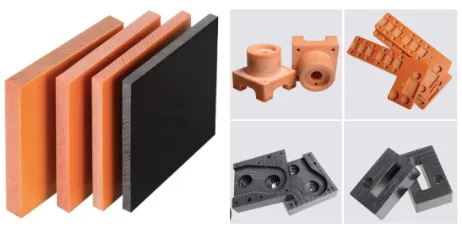
ESD Bakelite Sheets
ESD Bakelite Sheets
ESD bakelite sheet is a specialized electrostatic discharge-safe laminate used to protect sensitive electronic components, workbenches, jigs, and fixtures from static damage in industrial and electronic manufacturing environments. ESD bakelite sheet combines high mechanical strength with controlled surface resistivity, making it ideal for PCB assembly lines, testing fixtures, and precision tooling in ESD-safe work areas. ESD bakelite sheet helps factories, repair centers, and laboratories improve product reliability, reduce failure rates, and comply with ESD safety practices.
What is ESD Bakelite Sheet?
ESD bakelite sheet is a high-pressure phenolic laminate engineered with electrostatic discharge control properties for use in electronics and industrial applications. ESD bakelite sheet is manufactured from layers of impregnated paper or fabric combined with phenolic resin and conductive or dissipative additives to control static build-up. ESD bakelite sheet is designed to maintain stable electrical properties while offering excellent dimensional stability, machinability, and mechanical strength for demanding environments.
Key Features of ESD Bakelite Sheet
ESD bakelite sheet offers a unique combination of electrical, mechanical, and thermal characteristics suitable for static-sensitive areas.
-
High mechanical strength suitable for fixtures, jigs, and structural parts.
-
Controlled surface resistivity for safe dissipation of static charges in ESD-protected zones.
-
Good dimensional stability and low moisture absorption for consistent performance over time.
-
Excellent machinability for CNC routing, drilling, milling, and custom fabrication.
-
Good heat resistance suitable for soldering environments and PCB processing areas.
-
Durable surface resistant to wear, abrasion, and common industrial handling.
ESD bakelite sheet is available in multiple thicknesses and sizes, allowing easy customization for benches, shelves, trays, and tooling plates. ESD bakelite sheet can be precisely machined to create complex profiles, slots, and mounting points required in electronics manufacturing and testing setups.
Applications of ESD Bakelite Sheet
ESD bakelite sheet is widely used wherever electrostatic discharge control and mechanical rigidity are required together.
-
Workbench tops and table surfaces in ESD-safe electronic assembly lines.
-
PCB assembly fixtures, soldering jigs, and inspection fixtures.
-
Test jigs and holders for electronic components and modules.
-
Machine base plates, insulation plates, and mounting panels in control cabinets.
-
Storage racks, shelves, and trays for sensitive electronic components.
-
Spacer plates, adapter plates, and support structures inside test equipment.
In modern electronics manufacturing, ESD bakelite sheet plays a critical role in protecting ICs, microcontrollers, sensors, and other static-sensitive parts from latent and catastrophic ESD damage. ESD bakelite sheet helps minimize rework, rejects, and warranty failures arising from uncontrolled electrostatic discharge events.
Benefits of Using ESD Bakelite Sheet
Using ESD bakelite sheet in industrial and electronic facilities offers multiple operational, quality, and safety benefits.
-
Protects sensitive electronic components from static damage during assembly and testing.
-
Reduces product failures and improves long-term reliability of electronic devices.
-
Supports compliance with ESD-safe handling practices in production environments.
-
Provides strong, rigid, and long-lasting work surfaces and fixtures.
-
Improves process stability by offering consistent electrical and mechanical behavior.
-
Reduces maintenance frequency due to abrasion-resistant and durable surfaces.
Because ESD bakelite sheet is both structural and ESD-safe, it eliminates the need for separate mechanical and ESD layers in many designs. ESD bakelite sheet can directly replace standard bakelite or non-ESD laminates in areas where electrostatic control is required, simplifying design and reducing complexity.
ESD Bakelite Sheet in Workstations and Benches
ESD bakelite sheet is an excellent material choice for ESD workstations and benches in production lines, service centers, and labs.
-
Used as the primary tabletop material for assembly and inspection benches.
-
Provides a hard, flat working surface that safely dissipates static charges.
-
Works seamlessly with ESD wrist straps, mats, and grounding systems.
-
Resistant to solder splashes, tools, and repeated component handling.
When used as bench tops, ESD bakelite sheet offers a clean, professional appearance while delivering reliable antistatic performance. ESD bakelite sheet can be fabricated with cutouts, cable slots, and mounting points for tools, monitors, and test instruments.
ESD Bakelite Sheet for Fixtures and Jigs
ESD bakelite sheet is widely chosen for building custom fixtures and jigs in electronics manufacturing.
-
Ideal for PCB holding fixtures in wave soldering, reflow, and manual soldering stations.
-
Suitable for alignment jigs, testing nests, and specific component positioning tools.
-
Maintains dimensional accuracy under operational loads and temperatures.
Because ESD bakelite sheet can be machined with high precision, it is easy to produce repeatable fixtures that hold boards and components securely without generating static. ESD bakelite sheet helps ensure uniform processing and consistent assembly quality.
Material Properties of ESD Bakelite Sheet
ESD bakelite sheet typically exhibits:
-
High flexural and compressive strength for reliable load-bearing performance.
-
Stable surface resistivity in the dissipative range for controlled discharge.
-
Good electrical insulation properties where needed outside ESD path design.
-
Resistance to many industrial chemicals, oils, and solvents.
These properties make ESD bakelite sheet suitable not only for ESD protection but also for general high-performance industrial applications where rigidity, insulation, and controlled static behavior are important.
Design and Fabrication Considerations
When using ESD bakelite sheet in projects, several design factors should be considered:
-
Choose thickness based on load, span, and stiffness requirements.
-
Ensure proper grounding connections where ESD control is required.
-
Avoid sharp corners and stress concentrators during machining.
-
Use appropriate cutting tools and feeds to achieve smooth edges.
ESD bakelite sheet can be processed with standard woodworking and plastic-processing tools, making fabrication efficient and cost-effective. Proper design and grounding ensure that ESD bakelite sheet fully delivers its static control and mechanical performance.
FAQs on ESD Bakelite Sheet
1. What is ESD bakelite sheet used for?
ESD bakelite sheet is used for ESD-safe workbenches, PCB fixtures, jigs, test setups, and structural components in electronic manufacturing and assembly areas. ESD bakelite sheet sheet protects sensitive devices from electrostatic discharge while providing strong and stable mechanical support.
2. How is ESD bakelite sheet different from normal bakelite sheet?
Normal bakelite sheet offers mechanical strength and insulation but does not control static discharge. ESD bakelite sheet is specially formulated with controlled surface resistivity to dissipate static charges safely, making it suitable for ESD-protected areas and electronics handling environments.
3. Can ESD bakelite sheet be machined?
Yes, ESD bakelite sheet can be machined using conventional tools such as saws, drills, mills, and routers. ESD bakelite sheet supports precise fabrication of complex fixtures, slots, holes, and contours, enabling custom solutions for specific production and testing needs.
4. Is ESD bakelite sheet suitable for high-temperature applications?
ESD bakelite sheet offers good thermal resistance and is suitable for many electronics processes, including environments near soldering and PCB handling. However, operating temperature limits depend on specific grade and thickness, so the suitability of ESD bakelite sheet should be matched with the process temperature.
5. How do you clean and maintain ESD bakelite sheet?
ESD bakelite sheet can generally be cleaned using mild, non-abrasive cleaners and soft cloths. Harsh chemicals and abrasive pads should be avoided to preserve the surface and ESD properties. Regular cleaning keeps ESD bakelite sheet working surfaces efficient and helps maintain stable static control.
6. Do I still need ESD wrist straps and other protection if I use ESD bakelite sheet?
ESD bakelite sheet is a crucial part of an ESD control system but does not replace other measures. ESD wrist straps, footwear, grounding points, and proper handling procedures should still be used along with ESD bakelite sheet to maintain a complete ESD-safe environment.
7. Can ESD bakelite sheet be used outdoors?
ESD bakelite sheet is primarily designed for indoor industrial and electronic environments. For outdoor use, exposure to UV, moisture, and weather must be evaluated against the specific grade of ESD bakelite sheet and its recommended operating conditions.
SEND QUERY
ESD Bakelite Sheets
ESD bakelite sheet is a specialized electrostatic discharge-safe laminate used to protect sensitive electronic components, workbenches, jigs, and fixtures from static damage in industrial and electronic manufacturing environments. ESD bakelite sheet combines high mechanical strength with controlled surface resistivity, making it ideal for PCB assembly lines, testing fixtures, and precision tooling in ESD-safe work areas. ESD bakelite sheet helps factories, repair centers, and laboratories improve product reliability, reduce failure rates, and comply with ESD safety practices.
What is ESD Bakelite Sheet?
ESD bakelite sheet is a high-pressure phenolic laminate engineered with electrostatic discharge control properties for use in electronics and industrial applications. ESD bakelite sheet is manufactured from layers of impregnated paper or fabric combined with phenolic resin and conductive or dissipative additives to control static build-up. ESD bakelite sheet is designed to maintain stable electrical properties while offering excellent dimensional stability, machinability, and mechanical strength for demanding environments.
Key Features of ESD Bakelite Sheet
ESD bakelite sheet offers a unique combination of electrical, mechanical, and thermal characteristics suitable for static-sensitive areas.
-
High mechanical strength suitable for fixtures, jigs, and structural parts.
-
Controlled surface resistivity for safe dissipation of static charges in ESD-protected zones.
-
Good dimensional stability and low moisture absorption for consistent performance over time.
-
Excellent machinability for CNC routing, drilling, milling, and custom fabrication.
-
Good heat resistance suitable for soldering environments and PCB processing areas.
-
Durable surface resistant to wear, abrasion, and common industrial handling.
ESD bakelite sheet is available in multiple thicknesses and sizes, allowing easy customization for benches, shelves, trays, and tooling plates. ESD bakelite sheet can be precisely machined to create complex profiles, slots, and mounting points required in electronics manufacturing and testing setups.
Applications of ESD Bakelite Sheet
ESD bakelite sheet is widely used wherever electrostatic discharge control and mechanical rigidity are required together.
-
Workbench tops and table surfaces in ESD-safe electronic assembly lines.
-
PCB assembly fixtures, soldering jigs, and inspection fixtures.
-
Test jigs and holders for electronic components and modules.
-
Machine base plates, insulation plates, and mounting panels in control cabinets.
-
Storage racks, shelves, and trays for sensitive electronic components.
-
Spacer plates, adapter plates, and support structures inside test equipment.
In modern electronics manufacturing, ESD bakelite sheet plays a critical role in protecting ICs, microcontrollers, sensors, and other static-sensitive parts from latent and catastrophic ESD damage. ESD bakelite sheet helps minimize rework, rejects, and warranty failures arising from uncontrolled electrostatic discharge events.
Benefits of Using ESD Bakelite Sheet
Using ESD bakelite sheet in industrial and electronic facilities offers multiple operational, quality, and safety benefits.
-
Protects sensitive electronic components from static damage during assembly and testing.
-
Reduces product failures and improves long-term reliability of electronic devices.
-
Supports compliance with ESD-safe handling practices in production environments.
-
Provides strong, rigid, and long-lasting work surfaces and fixtures.
-
Improves process stability by offering consistent electrical and mechanical behavior.
-
Reduces maintenance frequency due to abrasion-resistant and durable surfaces.
Because ESD bakelite sheet is both structural and ESD-safe, it eliminates the need for separate mechanical and ESD layers in many designs. ESD bakelite sheet can directly replace standard bakelite or non-ESD laminates in areas where electrostatic control is required, simplifying design and reducing complexity.
ESD Bakelite Sheet in Workstations and Benches
ESD bakelite sheet is an excellent material choice for ESD workstations and benches in production lines, service centers, and labs.
-
Used as the primary tabletop material for assembly and inspection benches.
-
Provides a hard, flat working surface that safely dissipates static charges.
-
Works seamlessly with ESD wrist straps, mats, and grounding systems.
-
Resistant to solder splashes, tools, and repeated component handling.
When used as bench tops, ESD bakelite sheet offers a clean, professional appearance while delivering reliable antistatic performance. ESD bakelite sheet can be fabricated with cutouts, cable slots, and mounting points for tools, monitors, and test instruments.
ESD Bakelite Sheet for Fixtures and Jigs
ESD bakelite sheet is widely chosen for building custom fixtures and jigs in electronics manufacturing.
-
Ideal for PCB holding fixtures in wave soldering, reflow, and manual soldering stations.
-
Suitable for alignment jigs, testing nests, and specific component positioning tools.
-
Maintains dimensional accuracy under operational loads and temperatures.
Because ESD bakelite sheet can be machined with high precision, it is easy to produce repeatable fixtures that hold boards and components securely without generating static. ESD bakelite sheet helps ensure uniform processing and consistent assembly quality.
Material Properties of ESD Bakelite Sheet
ESD bakelite sheet typically exhibits:
-
High flexural and compressive strength for reliable load-bearing performance.
-
Stable surface resistivity in the dissipative range for controlled discharge.
-
Good electrical insulation properties where needed outside ESD path design.
-
Resistance to many industrial chemicals, oils, and solvents.
These properties make ESD bakelite sheet suitable not only for ESD protection but also for general high-performance industrial applications where rigidity, insulation, and controlled static behavior are important.
Design and Fabrication Considerations
When using ESD bakelite sheet in projects, several design factors should be considered:
-
Choose thickness based on load, span, and stiffness requirements.
-
Ensure proper grounding connections where ESD control is required.
-
Avoid sharp corners and stress concentrators during machining.
-
Use appropriate cutting tools and feeds to achieve smooth edges.
ESD bakelite sheet can be processed with standard woodworking and plastic-processing tools, making fabrication efficient and cost-effective. Proper design and grounding ensure that ESD bakelite sheet fully delivers its static control and mechanical performance.
FAQs on ESD Bakelite Sheet
1. What is ESD bakelite sheet used for?
ESD bakelite sheet is used for ESD-safe workbenches, PCB fixtures, jigs, test setups, and structural components in electronic manufacturing and assembly areas. ESD bakelite sheet sheet protects sensitive devices from electrostatic discharge while providing strong and stable mechanical support.
2. How is ESD bakelite sheet different from normal bakelite sheet?
Normal bakelite sheet offers mechanical strength and insulation but does not control static discharge. ESD bakelite sheet is specially formulated with controlled surface resistivity to dissipate static charges safely, making it suitable for ESD-protected areas and electronics handling environments.
3. Can ESD bakelite sheet be machined?
Yes, ESD bakelite sheet can be machined using conventional tools such as saws, drills, mills, and routers. ESD bakelite sheet supports precise fabrication of complex fixtures, slots, holes, and contours, enabling custom solutions for specific production and testing needs.
4. Is ESD bakelite sheet suitable for high-temperature applications?
ESD bakelite sheet offers good thermal resistance and is suitable for many electronics processes, including environments near soldering and PCB handling. However, operating temperature limits depend on specific grade and thickness, so the suitability of ESD bakelite sheet should be matched with the process temperature.
5. How do you clean and maintain ESD bakelite sheet?
ESD bakelite sheet can generally be cleaned using mild, non-abrasive cleaners and soft cloths. Harsh chemicals and abrasive pads should be avoided to preserve the surface and ESD properties. Regular cleaning keeps ESD bakelite sheet working surfaces efficient and helps maintain stable static control.
6. Do I still need ESD wrist straps and other protection if I use ESD bakelite sheet?
ESD bakelite sheet is a crucial part of an ESD control system but does not replace other measures. ESD wrist straps, footwear, grounding points, and proper handling procedures should still be used along with ESD bakelite sheet to maintain a complete ESD-safe environment.
7. Can ESD bakelite sheet be used outdoors?
ESD bakelite sheet is primarily designed for indoor industrial and electronic environments. For outdoor use, exposure to UV, moisture, and weather must be evaluated against the specific grade of ESD bakelite sheet and its recommended operating conditions.
SEND QUERY
Our Testimonial
Very satisfying, Abhishek Jain have a good knowledge of the products.
The whole process of buying phenolic laminates (Bakelite Sheets and Rods ) and Peek Engineering Plastics sheet was so seamless. I just had to tell the owner about my application then he suggested these products. Finally found a reliable vendor for all our company's Plastic sheets and rods requirement.